How many staff should a church have?
A healthy church staffing ratio is commonly cited as one full-time-equivalent staff member for every 75 to 100 people in attendance, per the Unstuck Group's church staffing research, though the number moves meaningfully with ministry model. A church running heavy small-group infrastructure or multiple campuses typically needs more staff per attendee than a single-service, single-site church of the same size.
A healthy staffing ratio is commonly cited as one full-time-equivalent staff member per 75 to 100 people in attendance, per the Unstuck Group's church staffing research. That puts a church of 400 at roughly 4 to 5.3 total FTE. Ministry model moves the real number: multi-site and small-group-heavy churches need more staff per attendee than a single-service church the same size.
You are probably trying to answer "are we understaffed" or "can we afford to add someone" without a clean number to point to. This post gives you the benchmark ratio, what typical staffing looks like at 200, 400, and 800, and how it ties to the budget question your board is probably also asking. It is one piece of what church staff actually costs as a whole.
This question tends to surface at a specific moment: growth has stalled, a key volunteer just burned out, or a staff member quietly mentioned they are covering three people's worth of work. Those moments are when "are we understaffed" stops being theoretical and starts needing an actual answer, and a ratio grounded in real research beats a gut feeling every time.
How many staff should a church actually have?
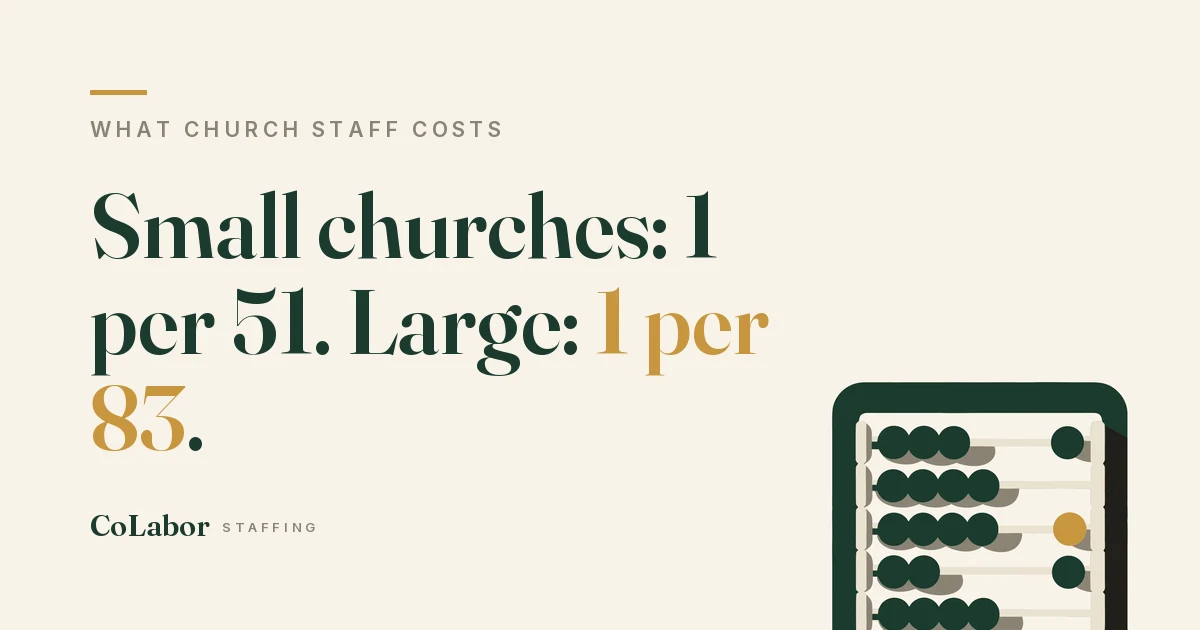
The Unstuck Group, the church consulting firm led by Tony Morgan, recommends one full-time-equivalent staff member for every 75 to 100 people in average weekly attendance as a healthy target. Their research on actual staffing levels across churches found the real average runs tighter than that: about one FTE per 64 attendees overall, with meaningful spread by size. Churches under 200 attendance average about one FTE per 51 attendees, a much richer ratio than the recommended benchmark. Churches over 1,000 attendance average about one FTE per 83 attendees, closer to the top of the recommended range.
That gap between "recommended" and "actual" is the whole story of this post. Small churches tend to run richer staffing ratios than the benchmark suggests, often because one person wears several hats and the FTE math counts them fully even though no single ministry area gets a dedicated person. Larger churches tend to run leaner, closer to the benchmark, because specialization and administrative systems let each staff hour cover more ground.
The Unstuck Group calculates its FTE figure by adding up the total hours all part-time staff work and dividing by 40, then adding that to the full-time headcount. That detail matters if you are running your own numbers: a church with five part-time staff at 20 hours each is carrying 2.5 FTE from that group alone, even though it looks like five people on an org chart. Count hours, not headcount, or your own ratio will look richer than it actually is.
What does staffing typically look like at 200, 400, and 800?
| Attendance | At the recommended 1:75 to 1:100 ratio | Roles commonly present |
|---|---|---|
| 200 | 2 to 2.7 FTE | Lead pastor, administrator (often part-time) |
| 400 | 4 to 5.3 FTE | Lead pastor, administrator, worship leader, executive assistant often appears here |
| 800 | 8 to 10.7 FTE | Above, plus youth pastor, executive pastor typically present, operations manager often appears in this range |
Math applies the Unstuck Group's recommended ratio directly. Actual reported staffing runs richer at small churches (about 1:51 under 200 attendance) and leaner at large ones (about 1:83 over 1,000), so treat the FTE counts here as a planning benchmark, not a ceiling.
The role list lines up with what we see across the site's role guides. Our executive assistant benchmark puts that role's typical arrival point between 250 and 400 attendance, once a pastor's inbox and calendar start cutting into sermon prep. Our operations manager benchmark puts that role's typical arrival point between 500 and 800, once three or more administrative or facilities functions are running with no single owner. Both thresholds sit inside the same staffing arc this table describes: responsibilities specialize in roughly that order as a church grows.
What changes the ratio besides raw attendance?
Three factors move the real number more than attendance alone:
- Ministry model. A church running heavy small-group infrastructure needs staff to recruit, train, and support group leaders, hours that a single-service church without that infrastructure does not need at all.
- Multiple campuses or services. Each additional campus or service adds a layer of coordination and often a partial or full role dedicated to running it, independent of total attendance.
- Facility and program complexity. A church running its own school, a large children's ministry with strict ratios, or a heavily programmed midweek calendar needs more staff hours per attendee than one with a simpler Sunday-only footprint.
- Volunteer culture and depth. A church with a deep, well-trained volunteer base can run a leaner paid-staff ratio because volunteers are genuinely carrying load that a thinner volunteer culture would push onto paid staff instead. This is the factor boards most often forget to name out loud, because it does not show up on an org chart.
Use this as a starting question, not a verdict
If your church runs noticeably leaner or richer than the benchmark, the ratio alone does not tell you which one is right. It tells you where to start asking why. A church at 1:120 with heavy small groups is probably genuinely stretched. A church at 1:120 with a single Sunday service and light programming may simply be efficient.
How does this connect to the budget-percentage question?
Staffing ratio and staff cost as a percentage of budget are two views of the same underlying question, and a board that only checks one is missing half the picture. A church can look understaffed by ratio while still running a high staff-cost percentage, if the roles it does have are paid well above market. We cover that side of it in what percentage of your budget should go to staff. Read both before you bring either number to your board.
In practice, most boards find one of two patterns when they run both numbers side by side. Either the ratio and the percentage agree, understaffed and under-budget, or overstaffed and over-budget, in which case the path forward is clear. Or the two numbers disagree, which is the more common and more interesting case: understaffed by ratio but not over budget on percentage, which usually means the church is underpaying relative to market and needs to raise compensation before it needs to add headcount. Or adequately staffed by ratio but running a high percentage, which usually means pay has drifted above market for the roles the church already has.
What if the ratio says understaffed but the budget says no?
This is the position most churches between 200 and 800 attendance actually sit in: the ratio math says another hire would help, and the budget committee says there is no room for another full-time local salary, benefits, and equipment line. The honest answer is not always "wait and stay stretched." Sometimes the workload driving the gap is real but does not require a traditional full-time local hire to close it.
CoLabor Staffing places full-time Christian co-laborers with churches and Christian-owned businesses. A generalist co-laborer can absorb 40 hours of the administrative load that is quietly stretching your ratio thin, at a fraction of what a traditional full-time local hire costs once payroll tax, benefits, equipment, and turnover are counted.
Check your own ratio
Add up your current FTE, divide your average weekly attendance by it, and compare the result to the 75 to 100 benchmark above.
Back to the benchmarkAdd capacity without a full headcount
If the ratio says you need more hands and the budget says no to another full-time local hire, both of our prices are published: $1,997 a month for a generalist, $2,997 for a specialist.
See pricingCommon questions
How many staff should a church have?
The Unstuck Group recommends roughly one full-time-equivalent staff member for every 75 to 100 people in average weekly attendance as a healthy benchmark, though the right number moves with ministry model.
Does the staffing ratio change with ministry model?
Yes. Multi-campus and small-group-heavy churches typically need more staff per attendee than a single-site, single-service church of the same size.
What does typical staffing look like at 400 attendance?
Using the Unstuck Group's recommended benchmark of one FTE per 75 to 100 attendees, a church of 400 would run roughly 4 to 5.3 total FTE staff, though actual staffing levels vary widely by ministry model and church tradition.
What should a church do if it is understaffed but out of budget?
Right-sizing help for the specific workload, rather than adding a full headcount, is often the more affordable fix.